
9.0Exceptional
Lech Zürs am Arlberg
Austria's most beautiful ski village — Lech Zürs anchors Ski Arlberg, Austria's largest connected ski area, with 305km of pistes.
The Alps form the world's largest concentration of ski resorts, stretching across France, Switzerland, Austria, Italy, Germany, and Slovenia. The range's geography — high peaks, persistent winter weather patterns, and centuries of mountain culture — has produced an extraordinary diversity of skiing: from the vast linked domains of the Tarentaise and the Arlberg to intimate valley resorts still running vintage chairlifts. Most of the world's best-known ski brands are here: Zermatt, Chamonix, St. Anton, Val d'Isère, Verbier. The season runs from late November through late April at the main resorts, extending to May and June on glaciers. Infrastructure investment has been relentless: the Alps collectively host more high-speed lifts than any other ski region on earth.
Austria's most beautiful ski village — Lech Zürs anchors Ski Arlberg, Austria's largest connected ski area, with 305km of pistes.

The Jungfrau Ski Region — 211km of piste beneath the Eiger's north face, two car-free Alpine villages, and a UNESCO World Heritage backdrop.

Ski in the shadow of the Matterhorn across 322 kilometres of car-free Alpine perfection.

Home of the Espace Killy — 300 kilometres of high-altitude terrain forged around a World Cup race village.

The world capital of alpinism — where Mont Blanc reigns and skiing reaches its most extreme expression.

Four Valleys, a Freeride World Tour stage, and the most uncompromising lift-served off-piste in Switzerland.

The birthplace of modern skiing — where the Arlberg technique was born and the world's most demanding linked ski area awaits.

A beautifully designed chalet-style resort at the heart of Les Trois Vallées — the world's largest interconnected ski area.

The pinnacle of French Alpine skiing — four linked villages, 150km of immaculate pistes, and the gateway to Les Trois Vallées.

Italy's most exclusive ski resort — at the foot of Mont Blanc's south face, gateway to the Vallée Blanche and the Skyway Monte Bianco at 3,466m.

The world's most visited ski resort — 225km across 10 linked Tarentaise villages, a glacier at 3,250m, and an Olympic bobsled track.

Austria's glacier summit trio — three peaks above 3,000m, two glaciers, the October FIS World Cup, and the Ice Q above the Ötztal.

Austria's après-ski capital — a high-altitude Silvretta arena straddling the Austrian-Swiss border with one of Europe's longest seasons.

The Pearl of the Dolomites — an Olympic host town surrounded by UNESCO World Heritage rock formations and 120km of gloriously Italian skiing.

Europe's highest resort village — near-guaranteed snow at 2,300m, with direct access to the world's largest linked ski area.

One of France's largest and most diverse ski domains — 250 km across five linked villages beneath the Pic Blanc glacier, open into late April.

Italy's highest resort, skiing under the shadow of the Matterhorn — a high-altitude mountain with the longest season in the Alps.

The Skicircus — 270km linking four resorts in Austria's Kitzbühel Alps, with Saalbach at the heart of one of Austria's liveliest après-ski scenes.

Switzerland's most complex ski destination — six mountain sectors, 300km of pistes, and the world's most politically prominent resort.

France's most snow-sure resort — year-round glacier skiing at 3,456m, a 163-day season, and 300km shared with Val d'Isère via the Espace Killy pass.

The Pearl of the Alps — a car-free Swiss glacier village ringed by 13 four-thousanders, with one of the longest snow-sure seasons in the Alps.

The original Alpine luxury resort — founded by the Rothschilds in 1921 as the French answer to St. Moritz, with 445km in the Évasion Mont-Blanc domain.

Austria's most glamorous resort — a medieval walled town hosting the world's most famous downhill race.

Traditional Savoyard village at the heart of the Portes du Soleil — 600km of linked terrain shared with Switzerland.

Italy's highest resort and duty-free enclave — high-altitude snow reliability with some of the Alps' best value.

Four mountains, one pass — Austria's Schladming-Dachstein 4-Berge Skischaukel and the Hahnenkamm of Styria.

One of Europe's highest and most snow-sure ski areas — 220 km of piste with a year-round glacier summit at 3,600m above the Isère valley.

Switzerland's glacier resort — Klein Titlis at 3,028m gives Engelberg the longest season in Central Switzerland and a dramatic Alpine lift ascent.

Europe's highest resort village at 2,035m — the gateway to the 400km Via Lattea, a cross-border Italian-French ski area of extraordinary scale.
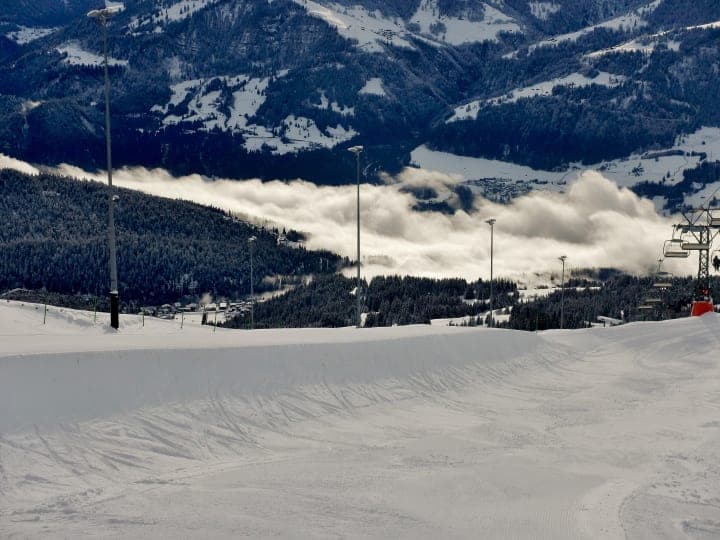
Switzerland's freestyle capital — a 200-metre halfpipe, four snowparks, and the Burton European Open since 1999.

Central Switzerland's fastest-growing resort — Vail Resorts' first European acquisition, and the mountain the rest of the industry is watching.

Austria's number one family resort — a car-free village served by a hovering underground railway found nowhere else on earth.

Two of the Ötztal's highest permanently inhabited villages, linked by gondola, trading on genuine snow-sureness rather than nightlife.

Switzerland's best-known luxury address, with 155km of mostly red and black piste on the Corviglia side of the Upper Engadin.

A choice of purpose-built bases, 200km of local piste and a train-and-funicular route from the valley floor, with the Paradiski link to La Plagne as an option.

Zillertal's lively valley town, with two contrasting ski sectors, 142km of piste and a well-known snowpark.

A sun-drenched plateau above the Rhône valley, skiing up to the Plaine Morte glacier with some of the most reliable weather in the Alps.

A historic Bavarian ski town beneath Germany's highest peaks — home of the Kandahar World Cup downhill.