
9.0Exceptional
Grindelwald
The Jungfrau Ski Region — 211km of piste beneath the Eiger's north face, two car-free Alpine villages, and a UNESCO World Heritage backdrop.
Best for
Strengths
Lower-scoring areas
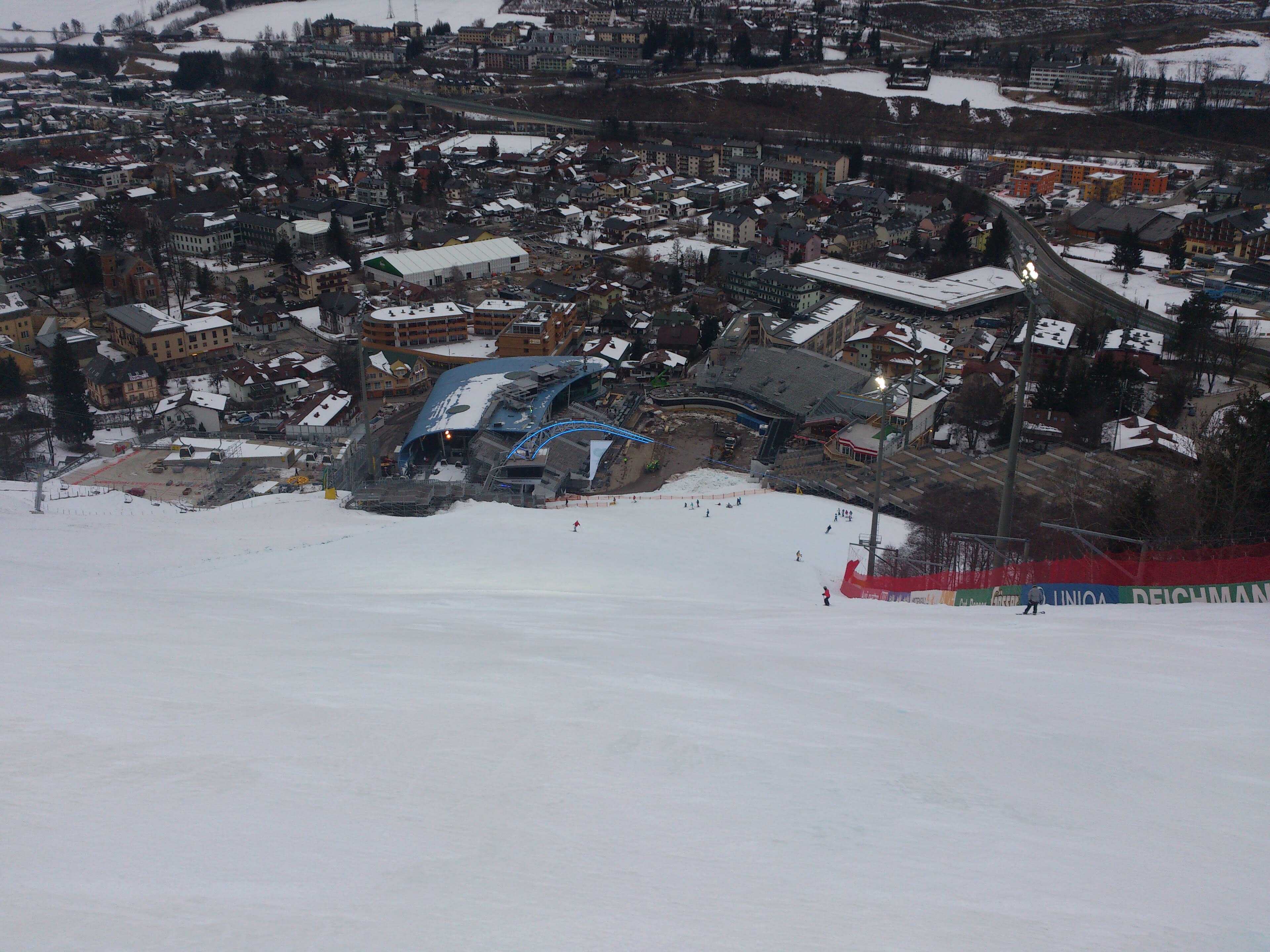
Schladming's identity rests on two pillars: World Cup racing and Austrian mountain hospitality. The Planai stadium run, built to FIS championship standards for the 1982 World Championships and substantially upgraded for 2013, hosts the January Nightrace — a men's slalom event held under floodlights with an atmosphere that packs the finish stadium beyond its 50,000-person capacity. That event brings global media and a genuine festival quality to the town for a week each year, and its influence on the resort's self-understanding is permanent. Outside the event window, Schladming is a working Styrian town: a market square, a river running through the centre, churches dating from the medieval period, and a population that lives here year-round. The ski resort wraps around this genuine community rather than replacing it.
The 4-Berge Skischaukel circuit connects four mountains on a single lift pass: Planai (1,894m summit, the main Schladming mountain), Hochwurzen (1,850m, accessed from the adjacent hamlet of Rohrmoos), Reiteralm (1,860m, quietest of the four, above Pichl), and Hauser Kaibling (2,015m, the circuit's highest point, above the village of Haus im Ennstal). The inter-mountain connections use ski buses on fixed routes; the circuit is skiable in a day for fit intermediates but requires early starts and attention to last-lift times. Planai's terrain is the most varied: the championship slope (Weltcupabfahrt) is open to the public outside race windows and offers a steep, high-quality red run; the rest of the sector has solid intermediate blues and reds through forest. Hauser Kaibling has the most challenging terrain in the circuit.
The Styrian Alps receive reliable snowfall from both Atlantic systems from the west and occasional Mediterranean influxes from the south, producing a consistent winter season. Planai's 1,894m summit is not the highest in the eastern Alps, but consistent northerly aspects and the altitude differential from the valley floor (728m) mean snow quality is generally good from December through March. Snowmaking covers the Planai stadium run, the main return piste to town, and key connecting terrain across the circuit. In warm or low-snowfall winters, the lower connections between mountains via ski bus are necessary; in good years, skiing between all four mountains is possible by piste. The stadium run's artificial snow base means the Nightrace venue is always race-ready regardless of natural snowfall.
The 4-Berge Skischaukel operates 47 lifts including the Planai gondola from Schladming town centre (a primary asset — walking distance from the train station and town square), a second gondola from Rohrmoos to Hochwurzen, and high-speed chairs across all four mountains. Planai Lifts, the operating company, has invested substantially in infrastructure in the years following the 2013 World Championships. The gondola from town to Planai is the circuit's most important lift and, on Nightrace week and busy Austrian school holiday weekends, can develop substantial queues; the Rohrmoos gondola provides an alternative entry. The inter-mountain ski bus connections (particularly Planai to Reiteralm and Planai to Hauser Kaibling) are efficient and well-timed.
Schladming's accommodation ranges from budget pensions and apartments in the town centre to four-star hotels on the mountain approaches. The Hotel Neue Post (in the historic market square) and the Stadthotel Schladming are the central hotel properties. A substantial apartment stock caters to families and groups; the market for British-style catered chalets is less developed than in France or western Austria. The resort's village is compact enough to walk — the main square to the Planai gondola is a 5-minute walk — and the train station is within the same walking distance. Rohrmoos (uphill from Schladming, closer to Hochwurzen) offers a quieter alternative base. Restaurants in the town are plentiful, good quality, and priced at reasonable Austrian mountain levels.
Salzburg is the primary gateway: 80km via the A10 Autobahn south and the B320 through the Enns valley, taking approximately 75 minutes. The Rudolfsbahn rail line from Salzburg via Bischofshofen provides a comfortable 90-minute train journey arriving directly at Schladming station, 300m from the Planai gondola — one of the best rail connections of any Austrian ski resort outside the Arlberg. Graz Airport (GRZ) is the alternative at approximately 150km; Austrian Federal Railways (ÖBB) connect Graz and Schladming in approximately 2 hours 30 minutes by rail.
Salzburg Airport is the closest major gateway — the 80km transfer via the A10 Autobahn and the Enns valley road to Schladming takes approximately 75 minutes in normal winter conditions. Innsbruck (INN) is approximately 2 hours via the A13 and B320 through the Enns valley. Schladming has a direct rail connection on the Enns valley Rudolfsbahn line, with Salzburg to Schladming taking approximately 90 minutes by regional train; the station is a short walk from the Planai gondola base. Multiple transfer services operate from Salzburg on fixed schedules.
Schladming is one of Austria's best-value major ski destinations. The 4-Berge Skischaukel 6-day adult lift pass costs approximately €225–260 (2024/25 season), covering all four mountains — excellent value by Austrian ski area standards. Accommodation costs are moderate for Austria: a double room in a three-star hotel in town costs approximately €80–130 per night with breakfast; apartments for families offer even better value. On-mountain food and drink follows standard Austrian pricing: a plate of Tafelspitz or Gulasch and a beer at a Schladming mountain hut costs approximately €20–28. The overall budget required for a week in Schladming is meaningfully lower than in Kitzbühel, St. Anton, or comparable Austrian destinations.
Adult 6-day 4-Berge Skischaukel lift pass approximately €225–260 (2024/25 season). Covers Planai, Hochwurzen, Reiteralm, and Hauser Kaibling. Verify current rates at schladming-dachstein.at.
This is an approximate editorial reference for the season noted. Always check the official resort website for current prices.
All price references are editorial estimates for the 2024/25 season. Current season prices may differ; verify at the official resort website before booking.
The Nightrace transforms Schladming for a week each January: 50,000+ spectators fill the finish stadium for the men's slalom, outdoor screens cover the stadium periphery, and the after-party spills across the town's bars until the small hours. Outside that event, the après-ski scene is lively but more contained: Hanglbar (at the base of the Planai stadium run, filling from 14:30), the Schi Schlucht, and the bars on the main square anchor the post-skiing hour. For dinner, the Stadtrestaurant Schladming serves classic Styrian cooking (Ritschert, local lamb, pumpkin oil dishes) in a large, properly Austrian setting; the Kirchenwirt and Zum Stadttor cover the traditional Gasthaus register at reasonable prices.
The Planai Weltcupabfahrt (the championship slope, run 1) is open to the public on non-race days and is worth a run for the experience: a genuine race piste, steep in the upper section, with the stadium infrastructure visible below. The Hauser Kaibling sector is consistently the quietest of the four mountains and has the most exposed, northerly terrain — arrive there by the connecting ski bus before 11:00 for the best conditions. Nightrace week (usually the last weekend of January) books out months in advance; if attending is the goal, accommodation should be secured as early as May for the following January. The Styrian wine and produce region of the Enns valley is worth exploring in the evenings — Schladming's restaurants have access to excellent local ingredients.
Après-ski 8.5 reflects Schladming's World Cup event infrastructure — the January Nightrace draws enormous crowds and the event culture shapes the resort's social scene throughout the season. Value for money 8.0 positions Schladming among Austria's most accessible major resorts: lift passes are priced below Arlberg and Kitzbühel levels for a comparable ski area size.
The Jungfrau Ski Region — 211km of piste beneath the Eiger's north face, two car-free Alpine villages, and a UNESCO World Heritage backdrop.

The world capital of alpinism — where Mont Blanc reigns and skiing reaches its most extreme expression.

The birthplace of modern skiing — where the Arlberg technique was born and the world's most demanding linked ski area awaits.
Support our independent research and help us add more ski resorts.
☕ Buy us a coffee