
9.0Exceptional
Lech Zürs am Arlberg
Austria's most beautiful ski village — Lech Zürs anchors Ski Arlberg, Austria's largest connected ski area, with 305km of pistes.
Best for
Strengths
Lower-scoring areas
Sölden is definitively an expert and intermediate resort, and it does not apologise for this. The BIG 3 route — three peaks above 3,000m, two glaciers, and 147km of piste — is what the mountain is built around, and the FIS World Cup races on the Rettenbachferner each October (before the main season, before most resorts in Europe have opened) are the public statement of what Sölden considers its season opener. The après-ski culture is a secondary pillar: the Fire & Ice Club and associated nightlife at the base are among Austria's most energetic, and the combination of serious skiing by day and serious partying by night defines Sölden's clientele profile in a way that distinguishes it from more family-oriented Tyrolean resorts. This is not Seefeld. The Ice Q restaurant at 3,048m — the James Bond set that became a permanent 007 exhibition — adds the final element: high-altitude gastronomy at a table looking down the Ötztal toward the Italian border, accessible by ski or gondola.
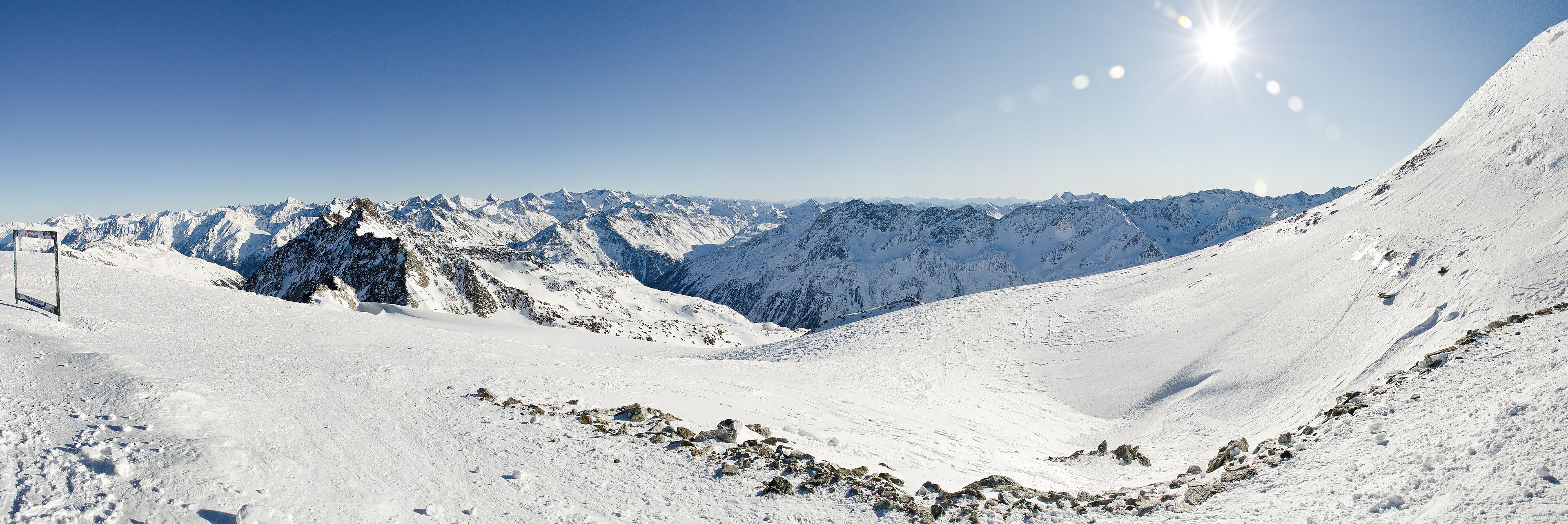
One hundred and forty-seven kilometres of piste span from base at 1,350m to glacier summit at 3,340m, a 1,990m vertical that is among the largest in the Eastern Alps. The BIG 3 route is the mountain's signature: Gaislachkogl (3,058m), Schwarzkogl (3,117m), and the Tiefenbachferner glacier connection at 3,309m, all linked by lift and piste to form a route across the resort's highest terrain that advances skiers can complete as a day's objective. The glacier sector (Tiefenbachferner and Rettenbachferner) provides the resort's early and late-season terrain and includes the FIS World Cup race piste — inspecting the Rettenbachferner under race preparation in October is a memorable experience for any ski racing enthusiast. The lower mountain terrain below 2,300m is more varied in pitch and includes the groomed intermediate cruising runs that constitute the majority of Sölden's daily skiing for most guests.
Two glaciers and a 3,340m summit create conditions that few Austrian resorts can match for season length or early-season quality. The Tiefenbachferner and Rettenbachferner glaciers open in late September — the World Cup races on the Rettenbachferner are the annual marker — and provide consistent skiing through the main season and into May. The main resort opens in mid-November and closes in early May; the glacier extends either end. Cold temperatures at 3,000m+ ensure snow quality stays excellent throughout the winter; the deep powder days on the glacier terrain after major snowfall events are among the finest in Austria. The lower mountain, below 2,000m, is more subject to mid-season temperature variation but snowmaking covers the key runs back to base.
Thirty-one lifts with a total capacity of 65,500 persons per hour serve the mountain — a high capacity figure reflecting Sölden's investment in modern, high-throughput infrastructure. For 2025/26, two chairlifts (Silberbrünnl and Einzeiger) have been replaced by new 8-seat Doppelmayr detachable chairs, improving connections in the mid-mountain sector. Three gondolas — the Gaislachkogl (to the Ice Q), the Giggijoch, and the Tiefenbachferner gondola — are the main mass-transit arteries. The overall lift network connects the two glacier areas, the BIG 3 peaks, and the valley base in a logical circuit that experienced skiers navigate without difficulty. Queuing is manageable on most days; the glacier gondola before the World Cup races and on opening-week weekends is the known pressure point.
Sölden village at 1,350m is a fully developed Austrian ski resort town: hotels from budget to five-star, self-catering apartments, restaurants, bars, and the après-ski infrastructure the resort is famous for. The main accommodation strip lines both sides of the Ötztal road through the village; most hotels are within walking distance of the gondola bases. Sölden is not architecturally distinguished — it is a functional Tyrolean ski resort village that has been built and rebuilt over 70 years of development — but it has genuine atmosphere, particularly in the evening when the après-ski venues are in full operation. Accommodation options range from Bergland Hotel (mid-range, well-located) to the five-star Hotel Das Central. The ski base area at Giggijoch can be accessed by shuttle bus; many skiers prefer to be within walking distance of the main Gaislachkogl gondola.
Innsbruck Airport (INN) is the recommended gateway: 90km north on the Brenner motorway (A13), turning west into the Ötztal at Ötztal Autobahn exit. The drive is straightforward and the road into the Ötztal is well-maintained. From Munich (MUC, 2.5 hours), the route is A8 to Innsbruck then A13 south to the Ötztal exit — a route well-signed and frequently driven by German ski visitors. Ötztal Bahnhof (station) provides rail access from the Inn Valley main line; resort shuttles run from the station. Sölden's position deep in the Ötztal (40km from the valley floor) means the approach road is scenic but a single access point; weather-related delays are rare as the road is well-maintained and gritted.
Innsbruck Airport (INN), 90km north of Sölden via the Ötztal Autobahn (A13), is the closest international airport — approximately 90 minutes in normal winter conditions. Direct ski-season services from London, Amsterdam, Brussels, and several other European cities run to Innsbruck throughout the winter. Munich International (MUC), 200km and approximately 2.5 hours by road, offers a far wider range of long-haul connections and is the primary gateway for intercontinental visitors. Both airports have well-organised transfer services to Sölden; Ötztal Bahnhof on the Inn Valley rail line (A13 motorway exit) is the rail-accessible point for train travellers from Innsbruck or Munich, with resort shuttle buses from the station. The Ötztal road into the valley is well-maintained year-round but narrows through the middle valley section; allow extra time during storm periods. Car hire from Innsbruck or Munich is the most flexible option.
Adult day lift tickets at Sölden run approximately €57–68 (2025/26 season; dynamic pricing, advance purchase recommended). The glacier day pass covering the Tiefenbachferner and Rettenbachferner is priced separately or included in the full resort pass depending on the season period — verify from soelden.com. Multi-day and season passes offer proportionally better value; a six-day ticket is typically the best per-day rate. Sölden's positioning as a premium Austrian resort is reflected in food and accommodation pricing: the Ice Q is a fine-dining restaurant at 3,048m and priced accordingly; mid-mountain alternatives cover the full budget range.
Adult day lift ticket approximately €57–68 (2025/26 season). Glacier day access may be priced separately in some periods. Verify current rates at soelden.com.
This is an approximate editorial reference for the season noted. Always check the official resort website for current prices.
All price references are editorial estimates for the 2025/26 season. Current season prices may differ; verify at the official resort website before booking.
Sölden's après-ski reputation is among the most specific in Austrian skiing: the Fire & Ice Club at the base of the Gaislachkogl gondola is the flagship venue, operating from 3pm until well after midnight with live DJs and a crowd that has come specifically for this experience. Philipp's Pub, the Schirmbar, and the Bierstadl round out the cluster. This après culture is a product and a draw: Sölden markets itself partly on this energy, and the crowd it attracts (international, young, experienced) reflects the marketing. For those not in the après-ski programme, the Ice Q at 3,048m is the dining highlight: table reservations required, 007 Elements exhibition included, views of the Ötztal from a glass-and-steel architectural statement that was designed by Baumschlager Eberle Architekten and is as striking in person as it appears on screen.
The BIG 3 route is best undertaken mid-week on a clear day — allow a full day, start early from the Gaislachkogl gondola, and verify that all three glacier connections are open before committing to the route. The Tiefenbachferner glacier terrain (accessible by the shuttle gondola from the Rettenbach car park) holds the most consistent early-season powder; a late September or October visit during the World Cup window gives access to the glacier and the race atmosphere simultaneously, before the main resort opens. The 007 Elements exhibition at the Ice Q is worth a dedicated visit — take the Gaislachkogl gondola to 3,058m and allow an hour for the exhibition before lunch. Book the Ice Q restaurant in advance for dinner; it is one of the most discussed mountain dining experiences in the Alps.
Snow reliability (9.0) reflects two operating glaciers plus a 1,990m vertical range — at 3,340m summit, the glacier terrain holds snow from late September through May and provides genuinely reliable conditions earlier and later than any non-glacier resort. Scenic beauty (9.0) reflects the Ötztal landscape: the high-alpine world above 3,000m, the BIG 3 route across three peaks, and the Ice Q/Gaislachkogl panorama are as dramatic as any ski scenery in Austria. Lift infrastructure (8.5) reflects 31 lifts with recent 8-seat Doppelmayr upgrades and a 65,500 persons/hour capacity — serious infrastructure for 147km of piste. Après-ski (8.5) reflects Sölden's documented culture as one of Austria's most energetic après scenes: the Fire & Ice Club and Philipp's Pub at the base are Tyrolian institutions. Beginner suitability (6.5) and family friendliness (6.5) honestly acknowledge that this is a high-altitude, glacier-heavy mountain where 55% of terrain is rated intermediate or above and the cold temperatures at 3,000m+ demand experience. Beginners and young families will find the mountain manageable but not its optimal use case.
Austria's most beautiful ski village — Lech Zürs anchors Ski Arlberg, Austria's largest connected ski area, with 305km of pistes.

The Jungfrau Ski Region — 211km of piste beneath the Eiger's north face, two car-free Alpine villages, and a UNESCO World Heritage backdrop.

Ski in the shadow of the Matterhorn across 322 kilometres of car-free Alpine perfection.
Support our independent research and help us add more ski resorts.
☕ Buy us a coffee