
9.0Exceptional
Lech Zürs am Arlberg
Austria's most beautiful ski village — Lech Zürs anchors Ski Arlberg, Austria's largest connected ski area, with 305km of pistes.
Best for
Strengths
Lower-scoring areas
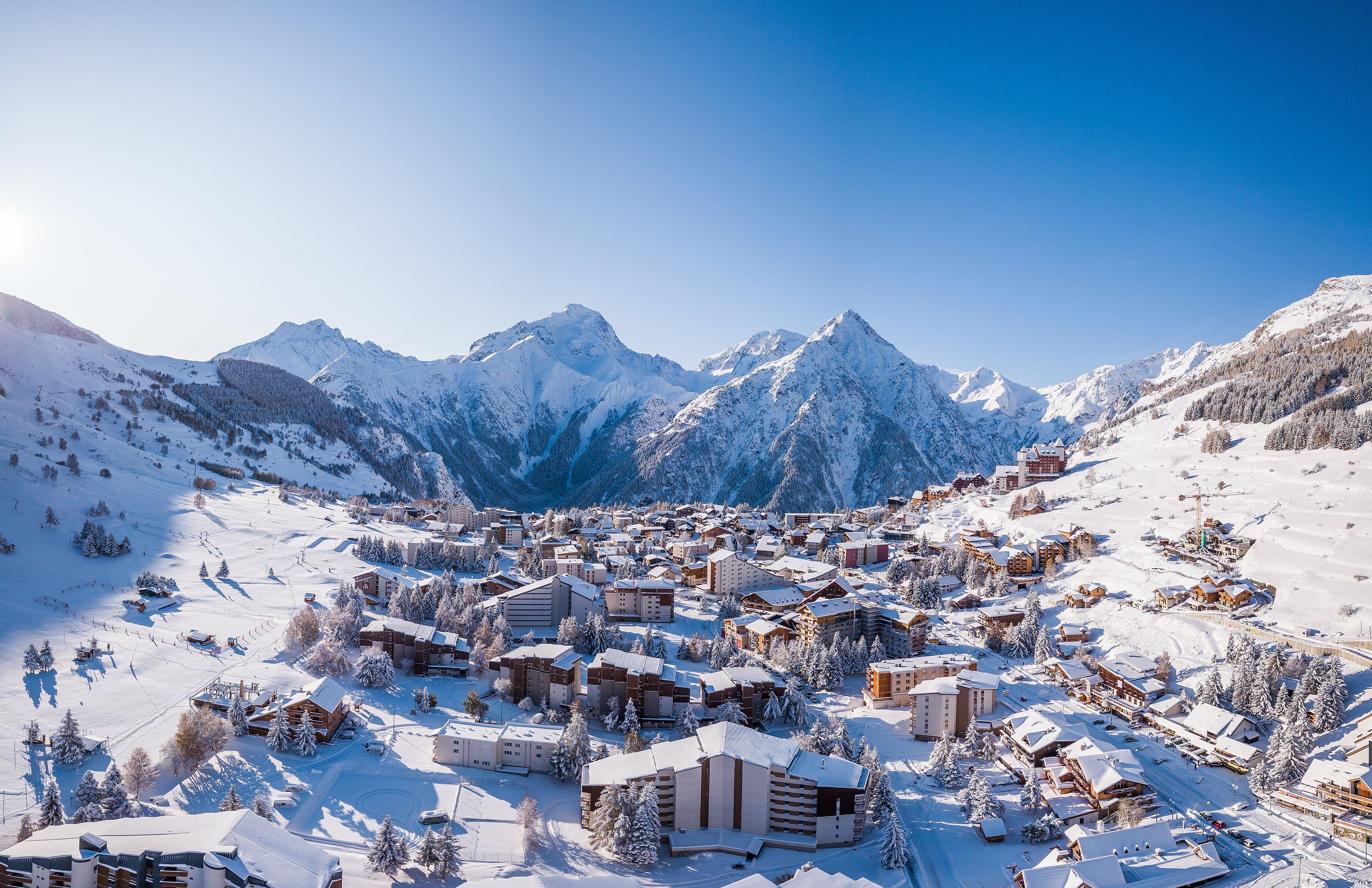
Les Deux Alpes was developed from the early 1940s and expanded significantly through the 1970s as a purpose-built high-altitude resort. The village name reflects its origins: the pistes were originally served from two separate alpine pasture areas, the Venosc alp below and the Mont de Lans alp above. Today the resort is a single long linear village running along a high ridge between those two historic access points, with the ski area extending from the funicular-accessible Mont de Lans base at 1,300m up to the Dôme de la Lauze glacier at 3,600m. The architecture is utilitarian — Les Deux Alpes has never tried to compete with the architectural charm of older Alpine villages — but the resort makes up for it in altitude, snow certainty, and genuine scale.
The ski area spans 220 km of piste across 96 runs, with a striking vertical range from 1,300m to 3,600m that creates a resort capable of skiing well into spring and offering genuine expert challenges alongside excellent beginner and intermediate terrain. The upper glacier above 3,200m is wide, high, relatively gentle, and exceptionally reliable for snow — it is the main reason families and groups with mixed abilities choose the resort, since beginners can ski at altitude on good snow while stronger skiers explore the rest of the domain. The lower mountain below 2,000m carries the most demanding terrain, including the steep and often mogulled black runs that drop through the Deux Alpes face. A network of marked off-piste itineraries extends the vertical and variety further for experienced riders.
The combination of a 3,600m glacier summit and a base altitude of 1,650m gives Les Deux Alpes one of the most reliable snow records in the French Alps. The glacier is skiable from the first week of the season through late April in winter, and from approximately mid-May to early July for summer skiing — the thermal gradients at this altitude mean that even spring temperatures on the valley floor have limited effect on the upper mountain. Lower-mountain pistes at 1,600–2,000m are more vulnerable to warm periods and rely on snowmaking for reliable early-season cover, but the sheer size of the domain means that skiers with altitude to play with rarely notice. The resort's position in the Romanche valley gives it excellent natural snowfall from Atlantic weather systems pushing up from the south-west.
The lift system comprises 41 installations including a funicular from the Mont de Lans lower base station, gondolas, and a network of high-speed chairs linking the main skiing areas. The Jandri Express gondola is the principal means of ascending from the main village to the upper glacier zone and its multiple stages provide access to progressively higher terrain. Queuing at peak periods can develop at key gondola access points from the village — this is a well-attended resort during French school holidays — but the well-staggered lift stations across the linear village distribute pressure more evenly than a single-funnel resort.
The village runs approximately 2.5 km along the ridge, with accommodation spread across a series of residential clusters connected by the Combe Froide piste and the resort's internal ski-bus network. The stock is predominantly self-catering apartments ranging from basic studios to more recent, better-appointed four-star residences; hotels are fewer than in some comparable resorts but cover the main market segments adequately. The sprawling layout means ski-in/ski-out access varies considerably by location — properties closest to the main Jandri gondola stations and the Venosc chair have the best access.
Grenoble Alpes Isère (GNB) is the closest airport at approximately 70 minutes by road, though its schedules are dominated by seasonal charters and budget routes. Lyon Saint-Exupéry (LYS) and Geneva International (GVA), both around 2–2.5 hours, offer the widest year-round flight connectivity and are the recommended primary options for most international travellers. The approach road climbs through the Romanche valley before ascending to the resort; it is well-maintained but the final section can require snow chains after significant snowfall, and the resort sits high enough that low-valley fog — which frequently grounds or delays flights at Grenoble and Chambéry — is not an issue on the mountain itself.
Grenoble (GNB) is the nearest airport at roughly 70 minutes, primarily served by seasonal charter and low-cost routes. Lyon (LYS) and Geneva (GVA) are strongly preferred for year-round flight access and run at approximately 2–2.5 hours under normal winter road conditions. The approach road from the Romanche valley climbs steeply; snow chains may be required after heavy snowfall, and the resort sits above the fog inversions that can affect lower valley airports like Grenoble and Chambéry.
Les Deux Alpes is priced broadly in line with mid-tier French Alpine resorts. A 6-day adult lift pass runs approximately €180–220 for the 2025/26 main season, with shoulder-season dates in November/December and late April carrying meaningfully lower rates. The resort has a strong self-catering tradition that keeps overall holiday costs below those of comparable accommodation-heavy destinations. Summer glacier skiing operates on a separate, shorter-day tariff structure.
Adult 6-day pass approximately €180–220 (2025/26 main season); summer glacier skiing available on separate day tickets. Verify current rates at les2alpes.com.
This is an approximate editorial reference for the season noted. Always check the official resort website for current prices.
The resort attracts a broad mix of French domestic skiers, British charter visitors, and a growing international clientele drawn by the glacier access and value-for-money positioning relative to the Three Valleys or Val d'Isère. Après-ski is lively without being as intense as some larger neighbouring resorts — the linear village layout means activity concentrates around a handful of bars near the main lift stations rather than a single central square. Mountain restaurants are good at multiple levels, with the upper glacier restaurants offering exceptional high-altitude views on clear days.
Ski the glacier early morning before any softening and before it opens to the main flow of visitors — the wide upper runs hold cold, grippy snow for the first few hours of lifts. The lower-mountain black runs below 2,000m provide the resort's most technically demanding terrain and are best in cold temperatures before they mogul significantly. For families with beginner skiers, the upper glacier is the resort's showpiece — book lessons or hire guides based at the top rather than at village level to make the most of the altitude. In poor-visibility conditions the lower mountain becomes unpleasant but the glacier often skis above the cloud base.
Snow reliability (8.5) is the resort's defining strength — the glacier at 3,600m gives Les Deux Alpes one of the most dependable snow records in the French Alps, with the ski season regularly stretching from late November to early May plus a summer glacier window. Village charm (5.5) reflects the resort's functional, purpose-built 1970s architecture; it was designed for snow access rather than aesthetics, and lacks the traditional character of neighbouring resort villages. Terrain variety (7.5) is solid given the 220 km domain but the distribution is weighted toward intermediate and glacier terrain rather than challenging expert lines.
Austria's most beautiful ski village — Lech Zürs anchors Ski Arlberg, Austria's largest connected ski area, with 305km of pistes.

The Jungfrau Ski Region — 211km of piste beneath the Eiger's north face, two car-free Alpine villages, and a UNESCO World Heritage backdrop.

Ski in the shadow of the Matterhorn across 322 kilometres of car-free Alpine perfection.
Support our independent research and help us add more ski resorts.
☕ Buy us a coffee