
9.0Exceptional
Lech Zürs am Arlberg
Austria's most beautiful ski village — Lech Zürs anchors Ski Arlberg, Austria's largest connected ski area, with 305km of pistes.
Best for
Strengths
Lower-scoring areas
Saas-Fee earns the nickname Pearl of the Alps through a combination of setting and restraint that is increasingly rare in Alpine resort development. The decision to ban private cars from the village in 1951 — made at the same time as the road from Saas Grund was built — has preserved the village centre in a state of pedestrian calm that purpose-built car-free resorts struggle to replicate. Walking the main street in winter, between traditional raccard granaries and chalet hotels whose wooden facades have been maintained without the modernisation that strips character from comparable Swiss villages, gives a sense of a place that has genuinely resisted the pressures of mass tourism. The glacier and the fourteen-thousand-metre peaks ring the plateau with a visual drama that makes the village feel both sheltered and exposed at once.
One hundred and fifty kilometres of piste break down into approximately 80km of green and blue runs, 45km of red, and 25km of black — a distribution that reflects Saas-Fee's appeal to a wide ability range and its particular strength as a beginner and intermediate resort. The glacier terrain in the upper mountain (above 3,000m) provides serious high-altitude skiing on the Mittelallalin plateau — wide, open, groomed runs that give beginners the experience of skiing at genuine altitude, and a context for more advanced skiers to extend their season. The expert terrain is concentrated on the north-facing runs descending from the glacier area and in the marked freeride zones, including the Alphubel and Allalinhorn approaches for ski tourers. The Felskinn-Mittelallalin connection via Metro Alpin is the unique infrastructure element.
Saas-Fee's snow reliability derives from altitude, orientation, and proximity to the Fee Glacier's cold microclimate. The 1,800m base receives snow in conditions that rain at lower Valais stations, and the north and north-east aspects of the upper mountain preserve powder quality well after storms. The winter season (late October to late April) is among the longest in the catalogue outside the handful of glacier resorts that operate year-round. The Fee Glacier has historically enabled summer skiing for national team training and dedicated enthusiasts, but climate-driven glacial retreat has made summer operations increasingly intermittent — in August 2026 the summer glacier ski area was suspended early due to heat and changing glacier conditions. The winter season itself remains fully reliable.
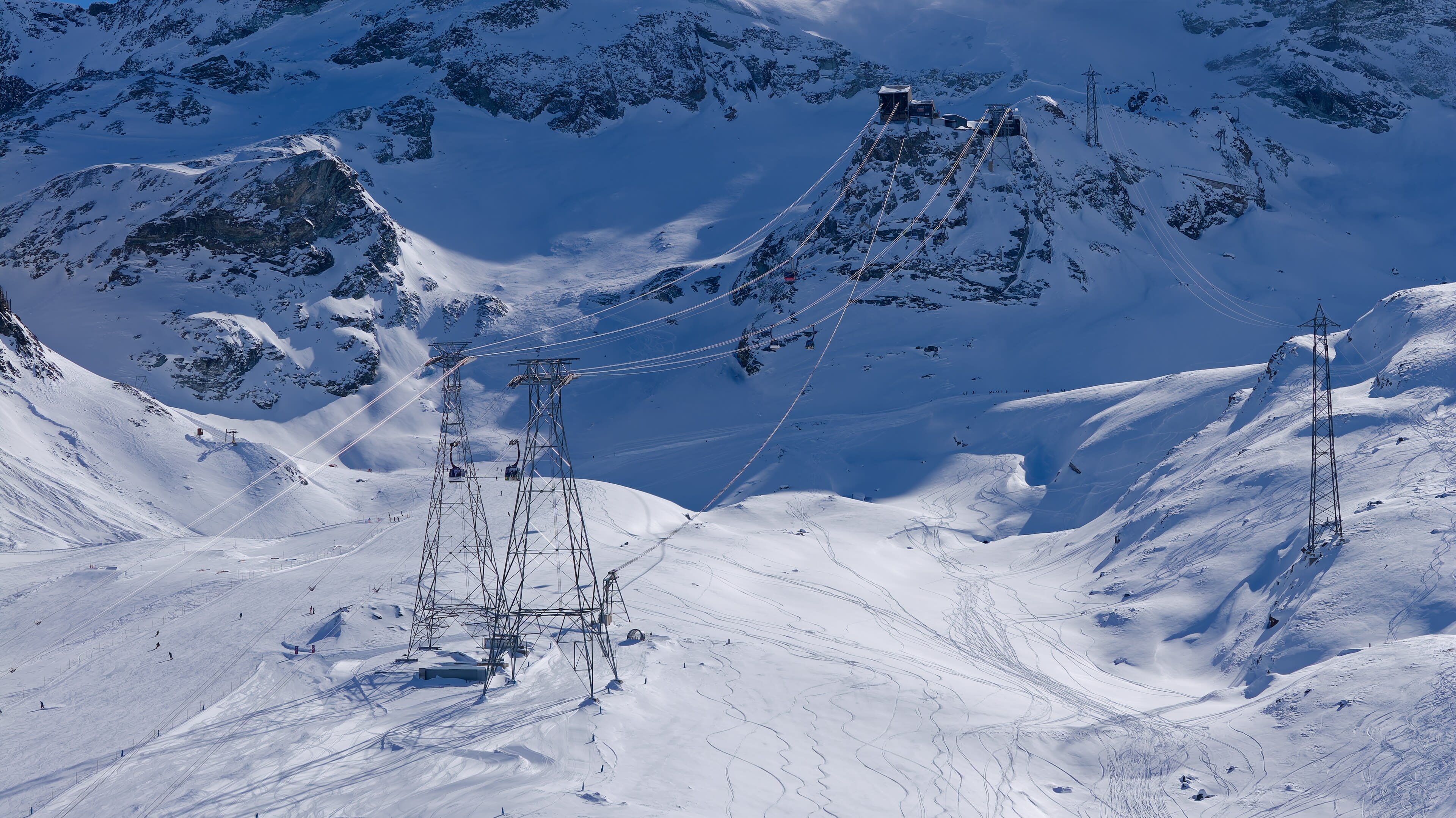
Twenty-two lifts including 3 cable cars, the Metro Alpin underground funicular, 5 gondolas, 2 chairlifts, and a series of surface lifts provide access across the ski area. The Metro Alpin is the resort's engineering centrepiece — an underground funicular that climbs from Felskinn (3,000m) to Mittelallalin (3,456m) inside the mountain, reaching the world's highest underground railway station. The Allalin revolving restaurant at 3,500m is the world's highest revolving restaurant, completing a set of altitude superlatives that are genuine rather than promotional. The overall lift system is well-maintained and sized appropriately for Saas-Fee's deliberate capacity management — queues are rarely excessive.
Saas-Fee has no cars and no through traffic — guests arrive by PostBus at the village terminal and proceed on foot or in small electric taxis. Accommodation ranges from traditional chalet hotels to larger wellness-spa properties, concentrated mainly along the main pedestrian street and in the area directly below the ski lifts. The village is compact enough that ski-in/ski-out access is effectively universal from properties close to the base. The four Saas Valley villages — Saas-Grund, Saas-Almagell, and Saas-Balen below Saas-Fee — provide alternative accommodation at lower prices with PostBus access to the resort. The SaastalCard, issued from the first night of accommodation, covers all PostBus and most cable car travel in the valley.
Visp is the rail junction that all routes converge on — hourly trains from Geneva, Zurich, and Milan via the Simplon/Lötschberg/Rhône main lines. From Visp, PostBus runs every 30 minutes to Saas-Fee (approximately 50 minutes up the valley). Car travellers follow the main Rhône Valley motorway to Visp, then the Saas Valley road to the village car parks — access beyond the terminal is restricted. The 25% discount on BLS car transport (via the Lötschberg car-shuttle tunnel from Kandersteg to Goppenstein) is a practical option for motorists approaching from the north, shortening the Bernese Oberland transit considerably.
All three gateway airports provide roughly equivalent drive times of 2.5–3.5 hours. The practical route from all three converges on Visp, the main town in the upper Rhône Valley, from which the PostBus runs every 30 minutes to the Saas-Fee terminal (no cars permitted in the village itself). Car travellers park in the large garages outside the village and continue on foot or electric taxi. Geneva is the most popular entry point for UK and northern European visitors; Milan Malpensa suits those arriving from southern Europe or long-haul connections via Milan. Train from Zurich or Geneva to Visp via the Rhône Valley main line, then PostBus, is a practical and scenic car-free alternative.
Saas-Fee is priced at the mid-to-upper end of Swiss resort pricing — above Verbier day-ticket equivalents but below Zermatt's premium. A 6-day adult ski pass runs approximately CHF 340–380 (2026/27 season), with the pre-season Special opening the season from late October at reduced rates. The Sleep & Ski packages that include a lift Flexpass with 4+ nights of accommodation are typically the best-value approach for a week's stay. Accommodation and dining are Swiss-priced — not cheap, but the value proposition is strong given the snow reliability and season length.
Adult 6-day ski pass approximately CHF 340–380 (2026/27 season). Pre-season and Sleep & Ski packages available. Verify current rates at saas-fee.ch.
This is an approximate editorial reference for the season noted. Always check the official resort website for current prices.
All price references are editorial estimates for the 2026/27 season. Current season prices may differ; verify at the official resort website before booking.
The après-ski atmosphere at Saas-Fee is notably quieter than Verbier, Zermatt, or the Three Valleys resorts — the village's size, its family orientation, and its relatively low-key nightlife positioning make it the choice for visitors who want quality mountain experience without the party resort energy. Restaurant quality is high across the village — the Schweizerstube at the Ferienart Hotel and the restaurant at the Allalin revolving station are the most notable venues. The village's calm pedestrian character extends into the evenings with a genuine café and bar scene without the excess of larger resorts.
The Felskinn–Mittelallalin sector in the early morning before crowds reach the glacier runs is Saas-Fee at its best: cold glacier air, wide empty slopes, and the Dom rising to 4,545m just to the north. The freeride zones off the Alphubel require clear conditions and should not be attempted in cloud or poor visibility — check the conditions board at the Felskinn cable car station. Book the revolving restaurant at Mittelallalin for lunch on a clear day — the 360-degree rotation takes approximately 50 minutes and the views include the Swiss, Italian, and French Alps simultaneously. The Dom guided ascent (a separate summer/autumn activity via the resort's glacier guide programme) is an extraordinary add-on for fit visitors spending a week.
Snow reliability (9.0) is Saas-Fee's defining technical strength — at 1,800m base and 3,600m summit, with north-facing glacier terrain that stays cold throughout the season, it is among the most reliably snow-sure resorts in the Alps outside of the high-altitude Three Valleys stations. Scenic beauty (9.5) reflects the extraordinary setting: 13 four-thousanders from every angle, the Fee Glacier above the village, and the Alpine light on the Allalinhorn and Dom. Village charm (9.0) recognises the car-free village as one of the most successfully preserved traditional Alpine settlements in the catalogue. The summer glacier skiing that historically distinguished Saas-Fee has become unreliable due to climate change — the Fee Glacier's summer operation has been suspended early in recent seasons (including August 2026) — and is no longer a bankable selling point. Winter season remains exceptional.
Austria's most beautiful ski village — Lech Zürs anchors Ski Arlberg, Austria's largest connected ski area, with 305km of pistes.

The Jungfrau Ski Region — 211km of piste beneath the Eiger's north face, two car-free Alpine villages, and a UNESCO World Heritage backdrop.

Ski in the shadow of the Matterhorn across 322 kilometres of car-free Alpine perfection.
Support our independent research and help us add more ski resorts.
☕ Buy us a coffee