
9.0Exceptional
Aspen Snowmass
Four mountains, one legendary ski town — from Buttermilk's beginner slopes to Highlands Bowl's world-class hike-to terrain.
Best for
Strengths
Lower-scoring areas
Vail was invented rather than discovered. In 1962, Pete Seibert and Earl Eaton identified the 10th Mountain Division's old training ground as an ideal ski mountain and built a resort from scratch, modelling the village on a Bavarian concept that produced the Tyrolean-flavoured architecture that still lines the pedestrian streets of Vail Village and Lionshead. That planned character — the bridges, the covered walkways, the regulated building materials — gives Vail a consistency that organic resort towns rarely achieve. It is a large, efficient, well-funded operation that happens to sit beneath a remarkable mountain, and it makes no apology for that. The clientele reflects the price point: wealthy, largely domestic, goal-oriented skiers who want the best and are prepared to pay for it.
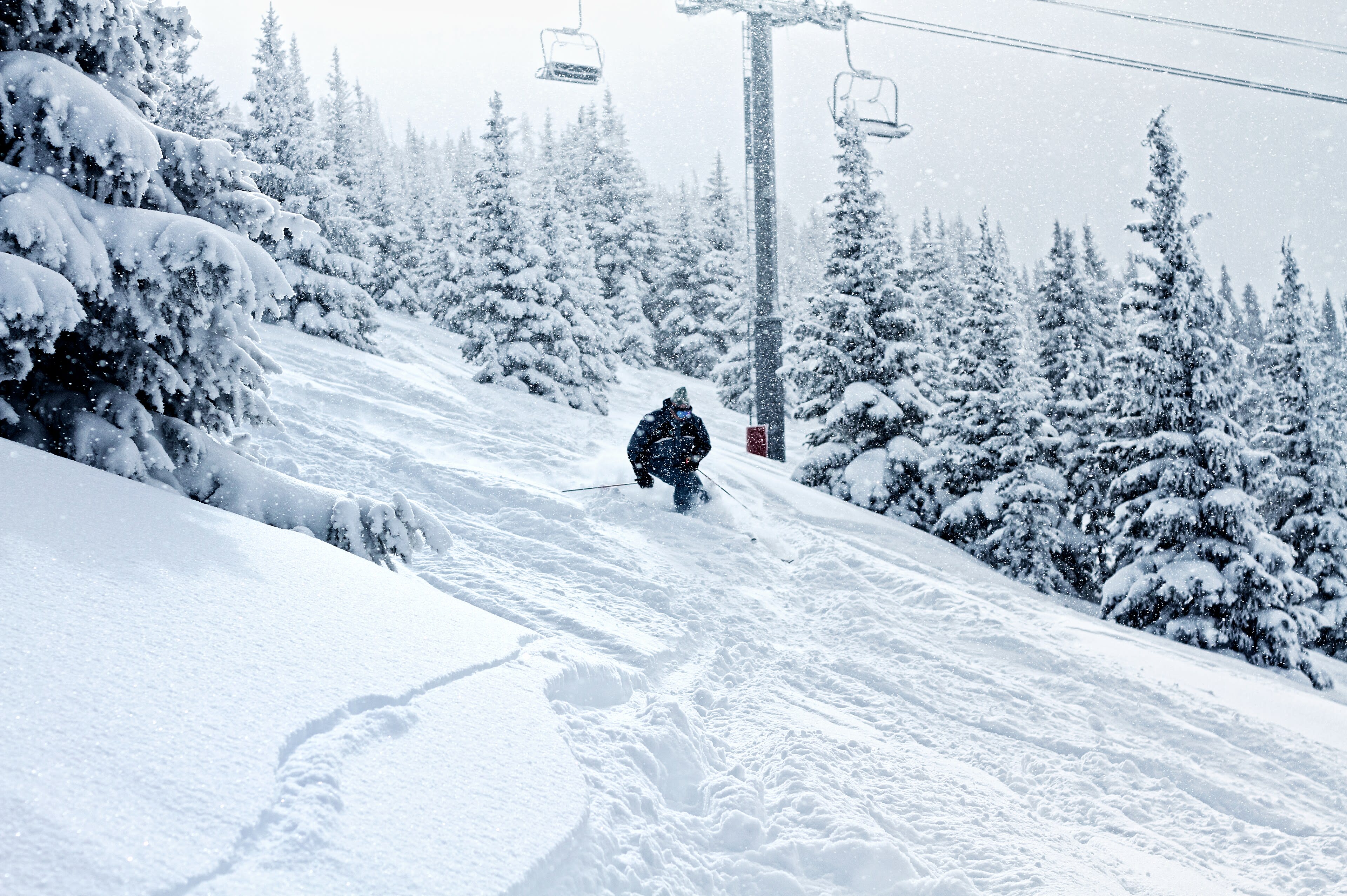
Vail's 5,473 acres divides into three fundamentally different experiences. The Front Side — facing north, heavily groomed, served by the main gondola and high-speed chairs — is the resort's backbone: long blue and black runs descending consistently from the ridge at 3,527m. The Back Bowls — Sun Down, Sun Up, China, Siberia, Tea Cup, Poppycock, Wok, and Inner Mongolian — spread south of the ridge across 2,643 acres of open, south-facing, largely ungroomed terrain that ranges from easy bowl skiing to serious steeps. Blue Sky Basin, to the east, is the most recent addition: quieter, more heavily forested, with narrower runs and a more adventurous character. For intermediates, Vail is exceptional — the groomed blue runs on the Front Side are among the longest and best-maintained in North America.
Colorado's continental snowpack — cold, dry, light powder — is Vail's natural advantage. The resort sits at one of the highest base elevations in North America (2,457m) and receives approximately 350cm of average annual snowfall, most of it arriving as the legendary Colorado champagne powder that skiers chase from coast to coast. The Back Bowls, facing south, can be affected by solar warming on sunny spring days, producing heavier snow by afternoon; the north-facing Front Side holds its quality longer. Snowmaking covers the key Front Side return runs and the connecting terrain between sectors. In a lean year, Vail's altitude provides a buffer that lower-elevation competitors cannot match.
Vail runs 31 lifts including the Eagle Bahn 8-person gondola from Lionshead, the Gondola One (Vail Village), and 12 high-speed detachable quad and 6-person chair lifts covering the front and back of the mountain. Lift technology is modern and well-maintained — Vail Resorts invests significantly in infrastructure across its portfolio. The Front Side is extremely efficiently served; the Back Bowls require a ridge traverse that can involve a short wait at busy periods. The Epic Pass — Vail Resorts' season pass covering 40+ resorts worldwide including Whistler, Park City, and Breckenridge — provides the most cost-effective access and is widely used by regular visitors.
Vail Village (around the gondola One base) and Lionshead (Eagle Bahn gondola base) are the two resort centres, connected by a free shuttle and walkable in good conditions. The Tivoli Lodge and Hotel Talisa are the premium hotel properties in Vail Village; the Arrabelle at Rock Resorts is Lionshead's anchor. Ski-in/ski-out condominiums and chalets — often rented at rates that make European luxury resorts look modest — dominate the higher-end accommodation market. The pedestrian villages have excellent dining and retail; the scale and funding ensure a quality of infrastructure that smaller resorts cannot match. Beaver Creek (a separate Vail-operated resort, 30 minutes west) offers an alternative base for those seeking a quieter atmosphere.
Eagle County Airport (EGE) is the destination airport for Vail, with direct seasonal flights from New York JFK, Chicago O'Hare, Los Angeles LAX, Dallas DFW, and Houston IAH among others. Check schedules carefully — service is seasonal (typically December through March) and capacity is limited. Denver International (DEN) has global connections but the I-70 mountain highway to Vail can be heavily congested on winter weekends; budget 3–4 hours including traffic. Multiple shuttle services (Colorado Mountain Express, Epic Mountain Express) operate from both airports on fixed schedules.
Eagle County Airport (EGE) is the primary gateway — a 35-minute drive on I-70 West, served by direct seasonal flights from major US hubs including New York, Chicago, Los Angeles, Dallas, and Houston. Denver International (DEN) is the alternative, with connections worldwide but a 2 hour 40 minute mountain highway drive on I-70 West (subject to heavy ski traffic on weekends and closures at Eisenhower Tunnel). Vail is served directly by the Colorado Mountain Express shuttle and multiple private transfer operators from DEN.
Vail is among the most expensive ski resorts in North America. A single-day lift ticket purchased at the window costs approximately USD 250–325 for the 2024/25 season — among the highest in the world. The Epic Pass (USD 950–1,100 per season) is by far the most cost-effective way to ski Vail regularly and includes unlimited access to Whistler, Park City, Beaver Creek, and dozens of other resorts. Accommodation costs are high: ski-in/ski-out condominiums start at USD 600/night and quickly reach USD 3,000+ for a quality two-bedroom. Food and drink pricing is in line with luxury US resort expectations.
Single-day window ticket approximately USD 250–325 (2024/25 season); Epic Pass (season pass) approximately USD 950–1,100 covering 40+ resorts. Verify current rates at vail.com.
This is an approximate editorial reference for the season noted. Always check the official resort website for current prices.
All price references are editorial estimates for the 2024/25 season. Current season prices may differ; verify at the official resort website before booking.
Après-ski in Vail centres on Vendetta's (Vail Village, traditional Austrian ambiance), the Tap Room (Lionshead), and the mountain's own outdoor deck at Two Elk restaurant on the Back Bowls-facing ridge. The energy is comfortable and social rather than intense; Vail's après scene is nowhere near the temperature of St. Anton or Ischgl but is well-funded and professionally run. For dinner, the choice is extensive: Elway's steakhouse (the renowned Denver chain has a Vail outpost), Sweet Basil (long-standing, consistently excellent American-European), and Los Amigos (relaxed Mexican at the base of the gondola) cover the main registers. The 10th Mountain Whiskey Distillery operates out of a small space in Vail Village and is worth a visit for context on the area's WWII military skiing history.
The Back Bowls require fresh snow to be at their best — within 24 hours of a snowfall, the wide-open south-facing terrain is extraordinary; after several sunny days, they can be heavy and tracked out. Check the snow report specifically for the Back Bowls before committing a day to them. Blue Sky Basin is the local's secret: reached by the High Noon Express or Pete's Express chairs, it has a very different character from the main mountain and is quieter on busy weekends. For the Epic Pass: purchase well before the season opens (usually in March for the following winter) when prices are at their lowest. Vail Resorts' pricing is dynamic — advance purchase can save USD 200–400 on the per-day rate.
Terrain variety 9.5 is among the highest in our dataset — the Back Bowls add a completely different skiing experience (wide, open, ungroomed bowl skiing) to the groomed Front Side, giving Vail genuine appeal across all ability levels simultaneously. Value for money 5.5 reflects Vail's position as one of the most expensive ski experiences in North America.
Four mountains, one legendary ski town — from Buttermilk's beginner slopes to Highlands Bowl's world-class hike-to terrain.

Wyoming's authentic mountain — Corbet's Couloir, the Aerial Tram, and the steepest lift-served terrain in North America.

Colorado's most beautiful ski town — a National Historic Landmark beneath 4,000m peaks, linked to Mountain Village by a free gondola.
Support our independent research and help us add more ski resorts.
☕ Buy us a coffee