
9.0Exceptional
Aspen Snowmass
Four mountains, one legendary ski town — from Buttermilk's beginner slopes to Highlands Bowl's world-class hike-to terrain.

Murray Foubister / CC BY-SA 2.0
Best for
Strengths
Lower-scoring areas
Steamboat Springs is the most authentically western ski resort in Colorado — a ranching and rodeo town that built a ski mountain rather than a ski mountain that built a town. The cowboy hats on Main Street, the hot springs, the Olympian graduates from the high school down the road, and the Champagne Powder® trademark that is both marketing asset and meteorological fact combine into a resort identity that no amount of Alterra corporate management has managed to homogenise. The mountain is large, well-equipped, and consistently snowbound; the town is engaged and genuinely local in a way that distinguishes Steamboat from Vail or Beaver Creek, which are constructed resorts with no pre-ski history. Six peaks, 170 runs, 3,741 acres, and a legal trademark on your snow's dryness — Steamboat plays its hand differently than any other major Colorado resort.
One hundred and seventy runs across 3,741 acres distribute across six mountain peaks: Christie Peak and Burgess Creek for beginner and low-intermediate terrain; Thunderhead and Sunshine Peaks for intermediate cruising; Storm Peak and Pioneer Ridge for the resort's steepest and most challenging terrain, including the famous tree runs — Shadows, Twilight, Closet, and the Morningside Park area — that are widely regarded as some of the finest tree skiing in the Rocky Mountain West. The terrain breakdown (14% beginner, 42% intermediate, 44% advanced/expert) reflects a mountain broadly accessible to intermediate skiers while maintaining serious challenge for experts. The 1,118m vertical is fully competent for a day's skiing; the six-peak breadth means repeat runs on the same descent are the exception rather than the norm.
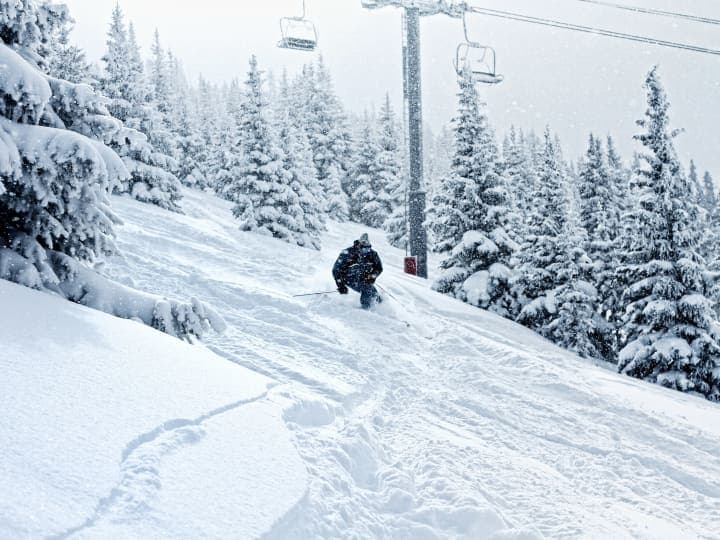
Champagne Powder® (registered trademark, USPTO 2008) is Steamboat's defining attribute and is not hyperbole. The Yampa Valley's position between the Elk Mountains and the Gore Range channels cold Arctic air from the north into contact with Pacific moisture, producing snow that averages approximately 6% water content — among the lightest powder measured at any major ski resort anywhere in the world. This compares to approximately 8–9% at the Utah resorts and 15% at wetter maritime resorts. The practical effect is that Steamboat powder turns in ways that no other Rocky Mountain resort can claim with the same scientific backing. Annual average snowfall of 400 inches (1,016cm) ensures consistent coverage across the season; the tree skiing holds powder for several days after a storm as the dense Engelmann spruce and aspen forest protects the surface from wind and sun.
Twenty-four lifts serve the mountain: three gondolas (Steamboat Gondola from base to Thunderhead; Tram at Thunderhead; Wild Blue Gondola from base to top of Storm Peak), one six-seat chair, eight high-speed detachable quads, four fixed-grip triples, two doubles, and six surface lifts. The Wild Blue Gondola, installed in 2022/23, significantly improved access to Storm Peak and Pioneer Ridge and is the single most impactful infrastructure addition in the resort's recent history. The three-gondola system means virtually the entire mountain is accessible from mid-mountain or base stations without long approaches. Lift lines at Steamboat are generally manageable by major Colorado resort standards — the resort's large acreage spreads skiers across a broader front than its visitor numbers would fill.
Steamboat Springs is a genuine Colorado ranching and resort town with a population of approximately 13,000 — enough to sustain an independent restaurant scene, a Main Street, and a local culture that predates skiing by a century. Accommodation ranges from ski-in/ski-out slope-side condominiums at the base area to downtown hotels and vacation rentals throughout Steamboat Springs itself. The Steamboat Grand Hotel provides the main full-service hotel at the base. The free Mountain Transit shuttle connects the mountain base and the downtown core. Strawberry Park Hot Springs (20 minutes north) and the Old Town Hot Springs (in town) give Steamboat's après-ski routine a thermal dimension available at no other major Colorado resort. Restaurants on Main Street include both the western steakhouse tradition and newer dining options that reflect the town's growing food culture.
Yampa Valley Regional Airport (HDN / Hayden Airport) offers seasonal ski-season flights from most major US hub cities; it is the preferred gateway and the most convenient option by a wide margin. Denver International (DEN), the year-round alternative, is 280km away via US-40 — a scenic but weather-dependent mountain highway crossing Rabbit Ears Pass; carry chains or snow tyres and budget for weather delays in active winter conditions. The Steamboat Express bus between Denver and the resort runs on a fixed schedule during the ski season. Intra-resort transport is handled by the free Mountain Transit system; a hire car is not required if basing in Steamboat Springs town or at the ski base.
Yampa Valley Regional Airport (HDN, also known as Hayden Airport) is the ski-season gateway, 40km from the resort, approximately 45 minutes. Winter seasonal flights from Denver, Dallas, Los Angeles, Chicago, Houston, and other major US cities connect to Hayden during the ski season — check availability early as the schedule is seasonal and fills quickly. Denver International (DEN), 280km and approximately 3 hours by road via US-40 and the Rabbit Ears Pass (occasionally winter-weather affected), is the year-round fallback with full international connectivity. Steamboat Express runs daily shuttle buses between Denver International and Steamboat Springs during the ski season; advance booking essential. Hire car from either airport is the most flexible option. Steamboat Mountain Transit operates free shuttle buses within the resort and to town throughout the ski season.
Day ticket pricing under Alterra's dynamic model ranges from $49 to $299 (2025/26 season), with the middle of that range — $80–130 USD — representing what most advance-purchase visitors actually pay. Ikon Pass holders ski Steamboat without day-ticket purchase; the Ikon Pass (annual, ~$999–1,099 USD) gives unlimited Steamboat access alongside 50+ other destinations worldwide. The resort's western Colorado location outside the Vail-Breckenridge-Keystone corridor means it draws a more Colorado-local, Midwest, and Great Plains clientele; crowd levels and pricing dynamics are generally calmer than the I-70 corridor resorts. Equipment hire, ski school, and resort dining are priced in the standard Colorado premium range.
Adult day ticket $49–$299 USD (dynamic pricing, 2025/26 season; advance purchase strongly recommended). Ikon Pass (unlimited access) accepted. Verify current rates at steamboat.com.
This is an approximate editorial reference for the season noted. Always check the official resort website for current prices.
All price references are editorial estimates for the 2025/26 season. Current season prices may differ; verify at the official resort website before booking.
Steamboat's atmosphere is genuinely bifurcated between mountain and town: on the mountain, it is a thoroughly modern Alterra operation with gondola-base espresso bars, mid-mountain table-service dining (Rendezvous Saddle), and a base area built for the ski-season crowd. In town, it is a western Colorado community with ranching traditions, a rodeo grounds, a Western art scene, and a restaurant culture rooted in cowboy cooking that has been augmented by the resort's growth without being entirely replaced by it. Old West Steakhouse has been a Steamboat institution for generations; Laundry Kitchen & Cocktails represents the newer wave. The après-ski move is to the Old Town Hot Springs pool, 4km from the ski base — heated naturally to 38–40°C, open in the evenings, and one of the most distinctive post-ski rituals available at any resort in the world.
Tree skiing at Steamboat is the highest-value terrain on the mountain — the Shadows, Twilight, and Closet runs on Storm Peak are among the finest gladed tree skiing in Colorado and hold powder for days after a fresh snowfall. Access the trees from the Storm Peak Express chair. For a powder morning, the Wild Blue Gondola to the top of Storm Peak opens at 8:30am and puts you in position for the best untracked lines before the weekend crowd arrives. Strawberry Park Hot Springs is best visited in the evening, 30 minutes before sunset — the natural pools under the stars in the snowscape above the valley is the après-ski experience that Steamboat locals consider its most special feature and many visitors don't discover until too late. Book the hot springs in advance (capacity-limited); hire a car or take the local service from the Springs Shuttle.
Snow reliability (9.0) reflects the documented Champagne Powder® meteorological phenomenon: 400 inches average annual snowfall at approximately 6% water content, produced by the specific atmospheric chemistry of the Yampa Valley. This is measurably distinct from standard Colorado powder and the score reflects that distinction. Terrain variety (8.5) reflects 3,741 acres across six peaks — the widest horizontal footprint of any Colorado resort in this catalogue — with 170 runs ranging from Christie Peak's genuine beginner terrain to Storm Peak's expert-level steeps and Morningside Park's tree skiing. Lift infrastructure (8.5) reflects 24 lifts including 3 gondolas, 1 six-seat chair, and 8 high-speed quads — modern, fast, and appropriate for the resort's scale. Village charm (8.5) reflects the genuine western Colorado town of Steamboat Springs (not a purpose-built resort village): cowboy culture, hot springs, independent restaurants, and a Main Street that was functioning long before the skiing began. Off-piste (7.5) acknowledges that Steamboat's fabled tree skiing (Shadows, Twilight, Closet) is genuinely excellent while noting the resort is not primarily an off-piste/backcountry destination.
Four mountains, one legendary ski town — from Buttermilk's beginner slopes to Highlands Bowl's world-class hike-to terrain.
Colorado's most famous mountain — 5,473 acres of Front Range skiing anchored by the legendary Back Bowls.

Wyoming's authentic mountain — Corbet's Couloir, the Aerial Tram, and the steepest lift-served terrain in North America.
Support our independent research and help us add more ski resorts.
☕ Buy us a coffee